
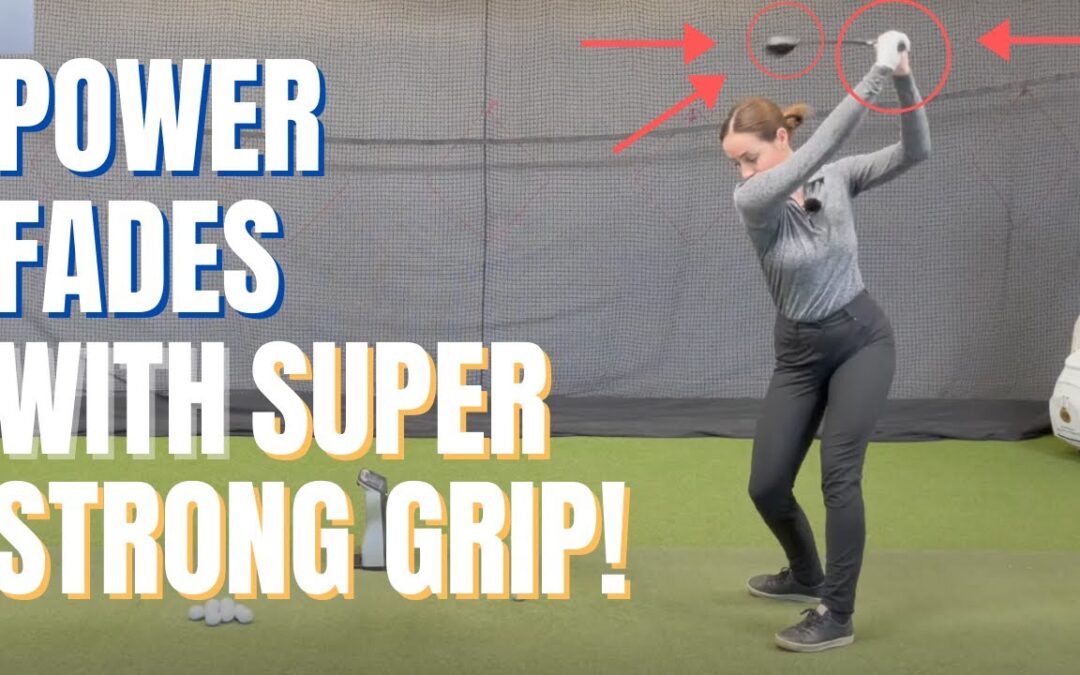
Hey everyone, Shawn Sav and Mu at your service. And today we're going to have an awesome session on showing you how to draw and fade the ball with any which way grip you have to a certain extent. Of course. So, Missy here, who's got this super strong grip and I know many of you are thinking, how, how can she fade the ball with that Well, she does it with ease and it's called power fades. And you're going to see right now in an instant, what that looks like. And them Mu and I will bring up the reinsure, you how to do that power draw at will. And today in my lesson, Sav, a person been fading, the ball, their whole life. I set them up. I, I explained to them properly what that's going to look like. And I'm going to show you what we're going to do with this, a volleyball dash soccer ball, and then the very first swing at a beautiful draw, right back on the green.
Never done that in his life. That was his first swing and it was a draw. So that was like my benchmark moment for a teacher. And we'll hopefully do the same thing for you in this session. So stay tuned right here right now. Of course, you're going to want to subscribe to our channel because we got such awesome information. And what else can we do Sav, Leave a comment down below and give us a thumbs up and make sure you hit the bell so you never miss the videos Right out of the gate. The analogy I use on a regular basis is soccer because most of us has have kicked a ball in one way, shape, or form, either a football or a soccer ball.
You notice that they rarely fly straight. And that's why Jack Nicklaus said it 40 years ago, stopped trying to hit the ball straight because it doesn't exist. We have, you know, our human-machine is designed to draw circles. So you're always swinging on an arc. If you're trying to hit something straight out of an arc, you literally have to hold on and manipulate that. And that will cost you serious yards. So when we're fading the ball or drawing the ball, they're, full-out abandoned whips in the direction that we want that ball to start and Stay left, stay left. And so Sam is going to first demonstrate to you. So let's say you're kicking a ball toward the camera's up. And you're going to kick that ball with since you're a lefty, you're going to kick the ball with your left foot and make it curve. It can start it to the left of the camera and make a curve back toward the camera.
How would you kick it? So everybody sees The direction of her kick is out to the left, but what part of the foot are you kicking with the inside of your foot and the inside of your foot is aimed way, right Yeah. So when you brush this way, you get a beautiful clockwise spin. Now, if you want it to do the other side, you would do it with your right foot or the outside of your left foot. Exactly. So either way with either foot. Okay.
So we're going to start you off with a little fade because everybody wants to know-how in the world are you ever going to fade the ball with that super strong grip Come on, show us your grips out. Right So isn't that beautiful, it's a beautiful grip. And this is because she's got little, teeny hands and little teeny wrists, and she can't do that big bowing stuff that you see big, strong, strong strapping people do, like Dustin Johnson and Brooks Koepka. You know, those are the guys that you're going to see out rather very limber, that They do that.
And they've done that ever since they were very, very little. And for you, if you're starting golf at 40 or 50 or 60 years old, it's extremely difficult to do because you're, you're not molded that way out of the gate. Yeah, exactly. Now, one thing I'd like to do with this particular shot though, so they understand how that works is we need to show it from down the line. Okay. So let's show you down the line right now, what it looks like. Sure. So Sav's going to hit fate. What we're looking for is a path that's moving to the right of the target and a clubface.
That's open enough where the club, you know, where the ball will come back to the target. We need to play the ball, a hair four to center. So fade, we're always playing the ball a little forward to center. Exactly is about the back of the ball touching center. Okay. So Sav a nice alignment to the right ball, position four to center. Now you're making the prediction. If you stay in that direction, does it feel like the ball starts in that direction It comes back? Yeah. And there we have it. Strong grip fade. Thank you very much. Good miss. So that's a good start. Yeah. So let's see it hit another one Hair. Look at that.
That was better. That's gorgeous. All right. Let's have a look at that one. So the That's your 200-yard club, right Yeah. You're basically losing about a half club and distance with it on, on the fade. Look at that path just slightly to the right face was two degrees open that not too much on the way down, not too much on the way up. Nice center contact right there. And you see it's straight, but you can see that it has, you know, four and a half degrees tilt to the left. So that's the perfect straight fade. And that's the perfect example for a fade. Yeah. So you have absolutely zero issues fading the ball with that grip, from the driver all the way to the wedges. And you know, the proof of that is if you look at how close the clubface if you look at Savy's clubface at the top of her backswing right now, you see how to shut that face it. And that's just like Dustin Johnson, Dustin Johnson has that exact same clubface in his swing. And you notice how deep he's able to take it to the target.
And that's what Savannah is doing. She's taking it through the ball and out toward the picture. Okay. Now you'll see a strong grip play, a beautiful draw. And the thing to look out for, and this is something that you want to take a look at in our fencing for power video, we talk about releasing a sword. So you've got two items that really determine the way you come through the golf ball. You need enough face closure. So check out our weak grip versus strong grip. So you understand dynamically what occurs in the swing. So you really understand what you need to, how you need to set up to deliver to your target. So we have a strong enough grip and then we need a full-out the release, even though, you know, you'll see Savannah has got this super-strong grip. She's releasing beautifully in the direction of the target. And we still have a nice rotation of the forearms through the shot. So now you'll see Mu do that with the draw. And that's something that he's really honed his skill on. And, it's extremely powerful.
So now with Mu, you've got seven art and we're going to be doing a draw, show us the grip the, in the radon screen here. So that's basically your strong grips. You notice how to crank that hand is. He's got a four-knuckle grip on this side and notice how that other hand is coming from a little bit more underneath. So when you swing and now if we want the draw, we're starting the ball to the left of the intermediate point left of the target and drawing it back toward the target right There.
It is pretty, very pretty. That was pretty simple. Yeah. You're becoming a one-take wonder there move. All right. So let's look at that Now. See how the path was coming in from the inside, moving to the left, faces five degrees closed, nice and flush. Almost a center strike right there. Yeah. And cause it's five degrees closed and taken off in that direction. Look at that beautiful draw that you there. Carry, was 207 carry.
So if you look at them, they have that, the replay looks absolutely awesome. So it starts off, I mean, look at that thing, shoot up in the sky. And then it's just a little left of the green right there. Yeah. Really nice distance. So very, very easy to home that and all you need to do that. You get, you know, you have the choice, you can do one of two things. You can start it a little less to the left, close the face a bit more. But if we look at the side spin it's at 609rpms. So I'm thinking that side spins really good. All we need to do is just keep an eye on your alignment, your ball position, and then just start the ball with just a little less left. Right.
Which is something that you used to struggle with. Really cool. Very well done. All right. So let's, let's show you the right-handed version of that now. So in this segment, when we do this fades and the draws, if we look at the ball position really important to understand ball position, if you play the ball too far forward, you're going to have a really hard time getting the ball to start to the right of your target if you're writing. So we typically want the front of the ball in the center of the stance for the draw. Now I can get behind it. And I feel like the swing is naturally moving to the right of my target. And if my face is closed enough, it's going to come back. And if I play the fade, I need to play the ball, just a hair forward, a center, aim a little bit more to the left so that the ball starts to the left of my target and then, and fades back to the target.
So it's important to leave it just a hair left of the target if you're playing as a righty. So let's have a look, so draw, okay, aiming at target ball back, get behind. Now let it release to the right edge of the intermediate point. The ball starts to the right draws back beautifully caught the right side of the green, the bad for a six iron. And then typically with a mid-iron. If I go for my fate, I should get just a little bit of a loss of distance on that for the fade, I'm going to stay left of the intermediate point, play the ball of hair for, to center. And I'm just gonna nice release to the left edge of that intermediate point. Stay left, stay left.
That started a little left and there's a little straight fade if it wasn't, the draw was, you know what I mean It was pretty darn close. So this is what's cool. My face was 0.3 degrees closed to that path. My path was one degree to the left. That's typically my straight fade right there. I could, you know, aim, you know, aim more to the left and swing a lot more to the left and open up that face. But I would lose a little bit of distance. So I like to play that straight fade. And, and there's, there's what it looks like. All right. Now, for those of you who have a neutral grip and a square face, you may find yourself struggling to hit the draw. Now, if you feel the need to bold the wrist manually, or turn the hands manually through impact your grip club relationship, isn't strong enough if you're able to, you know, if you feel that when you swing in the direction that you want to start the ball, the ball curves the way you want to. And you're nicely through the ball the way a Matt Wolf does it, then all the best to you. I don't want to change your grip.
I don't want to modify anything, but if you're really struggling, if you're telling me that you're early extending, and you're losing your lag over here, and you're losing a lot of power and you're hitting the shots very high, and you're losing a lot of distance, you feel like you should be ha you know, hitting the ball longer for your skill then your grip clubface relationship needs to be addressed. So if you look at Sav because she's strong enough in her grip, she's able to deliver. She's able to collect the ball here and release it out there. And we actually needed a double whammy with Mu.
We needed to not only give him a strong grip, but we needed to show him and develop how a full release happens in golf. And a full release is really easy to do. Just turn the club upside down, and you're just going to slash a sword or a machete. Imagine you've got a bamboo shoot here in front of you and give it a nice slash, and you'll notice how the weight of the club is going to want to release your anatomy. Don't try to place the ball in the direction that you want to start it. You want to release the club in that direction and then let, let it happen for you. Okay. So we can't be steering and manipulating the club. Now that helps answer. You know, if you've got a neutral grip with a closed face, well, that's the same thing as a square grip and a strong, a strong grip with a square face. So neutral grips closed or strong grip square. When you release in the direction that you want to start the ball and the ball is flying the way you want to then your grip club relationship is sound.
That's how it works. So that's why Sav's grip works for what she does, Mu's Grip works for it. What he does, my left-handed swing has a slightly stronger grip than my right-handed swing because of my dominant lead side. So I get, a much peppier release from my right side, and I get a little bit more of a tame release from my left side. Okay. So hope you guys enjoyed that. We'll see you next week.
.