
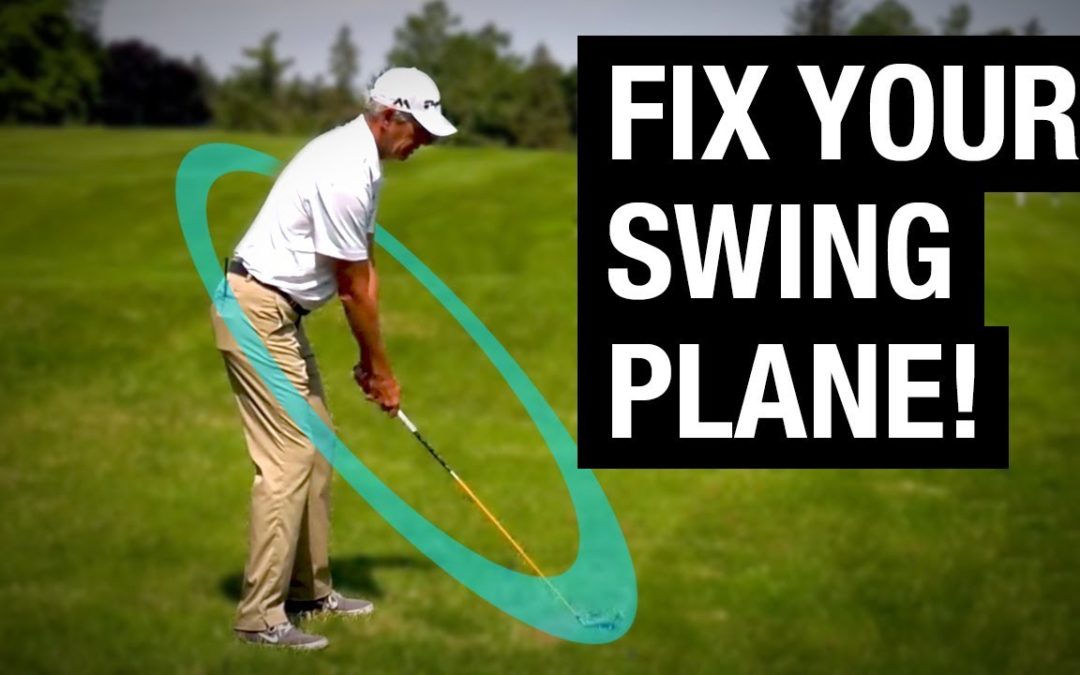
Hi, I'm Jim Roy, former PGA Tour and Champions
Tour player. I'm here in Syracuse, New York, at my home
course, Bellevue Country Club, and I want to talk a little bit about correcting swing
planes. Now, this is kind of a tough topic because
we're all kind of… We all definitely are built differently, we
have our own idiosyncrasies in our swing, and I really believe that the most important
part of the swing plane, when we're talking about that, is really, how are we from the
right hip to the left hip because we all have our little moves in the backswing.
You know, even on the PGA Tour, you'll see
Jim Furyk's swing, and Freddie Couples', and maybe Jason Dufner's, they're all different,
but they all arrive at impact in pretty similar positions. So, what I want to do is show you what I've
done throughout my golf career to try to keep my swing plane in check, and maybe some of
these little drills and feels that I do might help you. So, to start with, I always try to get in
a good athletic position at address, and for me, that starts with standing up nice and
straight, shoulders are back, arms are nice and relaxed out front. I'm going to crack my knees, I'm going to
keep my lower back straight, and just bend from the hips and let that club hit the ground
naturally. So, here, I feel nice and tall, which I like
to feel. I've got room here, and I feel like I'm in
a pretty good athletic position to get started. So, in my swing, I have a tendency to kind
of get up here and pick the club up, and I tried a lot of things to try to solve that,
but I guess it's just kind of my signature.
So, what I try to do, just so it doesn't get
way out of hand, is I have a little feel, that I like to drag this club head, I turn
it along the ground in a semi-circle to about middle of my right foot, and I lift my arms
up. And this position here is the position that
I'm comfortable with. My arms feel nice and extended, I've turned
my shoulders nicely, and I feel nice and relaxed. I don't feel like I've lifted the club up. Now, this position here was really accomplished
75% with my body, about 25% with an arm swing, but to complete the swing, it just reverses. I'm going to do 75% with my arms and 25% with
my body to get to the top of the swing. So, that feeling there is the feeling that
I'm constantly striving for. When I really start hitting the golf ball,
I kind of get up here, but this is the position I practice, and maybe, someday, I'll actually
get it right in the slot here, on plane. But, I'm not too concerned. Remember, we all have our little signatures,
and getting back down to impact is the most important thing.
So, from here, we're going to shift our weight
to our left side, the arms are falling straight down here, and we're approaching the ball
from the inside, and here's our impact position. So, being on plane, to me, means I'm in balance,
my chest is open, shoulders are pretty level, my weight is into my left side, and I feel
like I have the ability to turn and continue to be on plane, and all the way to my finish
where my right shoulder is the closest thing to the target, and this club is very parallel
to my shoulders. I don't want the club hanging down like this
because that's going to show me that I moved this way, versus around. So, once I do my drag-around drill, my arms
are extended, I feel real good here. You can see that the shaft is parallel to
my target line. This is one of five positions that the shaft
will be in this kind of a position if we're really on plane all the time. So, this would be position one for me.
So, from here, it's going to be a 75% move
with my arms, 25% move with the body to complete the swing. So now, I'm up here, I've completed my backswing. You can see now that the shaft, again, is
parallel to my target line, so that would be position two, as far as being on plane. As I start my downswing, I'm back halfway
down, into a similar position as to where I was halfway back.
So, this would be position three, as far as
the shaft being on plane. I go into impact, and as I turn through impact,
you can see now, the shaft is matched up to the same position it was over here, position
four, as far as being on plane with the swing. From here, my arms fold up as I continue to
turn. You can see that the shaft now, again, position
five, is pointing down my target line, so again, matching up, basically, with what it
was at the top of my swing.
And then, to complete the swing, I continue
to turn, where the club is now horizontal and level with my shoulders. So, those are kind of my benchmarks, my five
benchmarks that I want to check all the time to see if I'm close to those. Certainly, I'm most concerned with how I am
from hip to hip because that's where the moment of truth is in the golf swing. If you want to kind of really simplify it
and forget some of the takeaway and all that kind of stuff, you've probably seen, maybe
in past videos, how I've taken the club and put it on my shoulder, turned 90 degrees,
there's my backswing position. If I put it on my left shoulder, turn 90 degrees,
this would be my finish position, and then just turn so the club is horizontal. So, that's kind of the things that I work
on just to make sure I'm kind of in the parameters of the swing plane. Again, I know, everybody, I see a lot of videos
and everything where they've got the sticks in the ground, and I get it, but I think we
all have our own signature in our golf swing.
I think it's really important to continue
to work towards getting the swing on plane as possible, but I really believe that the
moment of truth is hip-to-hip, and we want to have that freedom through the ball to help
us hit the best shots we can. So, give these little checkmarks a try, see
if you're close. If not, work on one area and see if you can
improve..