
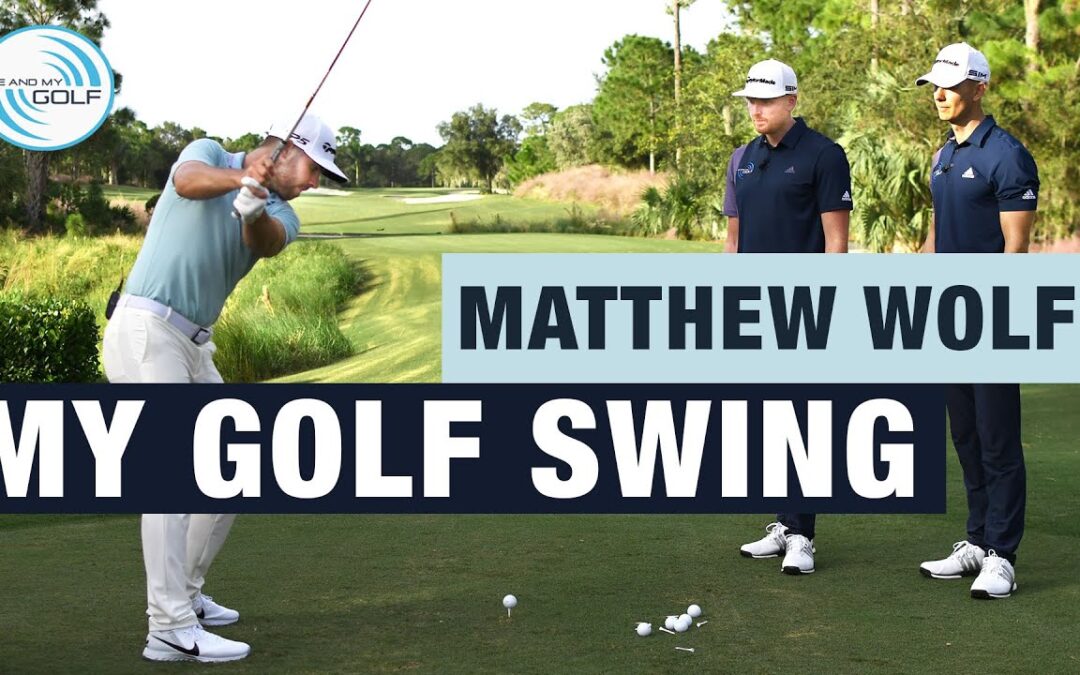
– Hello everybody and
welcome to the Floridian. Thank you for joining us. (upbeat electronic music) And we have a very special
guest, 20-year-old, and he's got his first
PGA Tour win already. This guy's one of the rising stars on the scene at the moment. Matt Wolff. Great to see you. – Yeah, thank you for having me. – Thanks for joining us. – Good to see you.
– Awesome. – How's things? – Great, you know. Here. Little hot (chuckles) but it's awesome, you know. The whole full ride of golf
and where it's taken me has been really special and looking forward to
the future, I guess. – Brilliant.
We can't wait
either. We can't wait either. So we're talking
obviously about your drive and we have to talk about your drive and we have talk about
your golf swing as well. It is quite unique, but I
tell you what we're gonna do before we start talking
much more about this, let's take the shot.
Let's see what you've got. – Lets see what it is. – We got TrackMan in play. You haven't really had a warm up. We said you've gonna have a warm up. We never had those warms up.
– Oh, no, he didn't, did he? (all laugh) – We'll see how it goes, yeah. Well, luckily like you said, I'm 20. – Exactly
– Exactly. – All right, see what numbers we get. (thunk of hitting ball) (beep) Okay, I mean, that's still in the air, it's gonna be there for a bit longer. – Little bit left but… – Hit another one. We'll
give you a proper warm-up. I'm gonna call these numbers
out. Club speed: 120 mph. 178, ball speed. Only 335
yards. That's not bad. – That was a smooth swing. – That was his starter.
(thunk) (beep) – That's crushed.
– Very nice. – And that's a little bit of fade. And you prefer the fade, don't you? – I do, yeah. – From people people have said. – Yeah, with a driver, I do
prefer a little bit of fade. I just think it's a lot easier to control. You know, you're trying
to optimize distance and everything like that. And I feel like in order to optimize it, you have to get such low
spin and with a draw- – Yeah, yeah. – It's kinda hard to
keep the ball in the air and get it to turn over but with the fade it kind of increases
that spin a little bit. So, it's a happy medium, yeah. – You don't need an advantage on the rest of the field, do you really? (laughter) – Hey, any advantage I could have over anyone on the PGA Tour,
I'll definitely take it.
– Cool, cool, cool. So, look, I mean, obviously, we said,
look, it is quite unique. We know your swing coach, George Gankas. And he's very much embraced this as well. It would've been so easy for George to change this golf swing. But he didn't, obviously, want to and loved what he saw. But
how did it evolve for you? What's behind this golf
swing that we see now? – Well, I used to play a
bunch of sports as a kid.
So, I played football,
basketball, but the biggest two, along with golf, that I played
were soccer and baseball. And I think, there are
things in that, you know, soccer and baseball that are incorporated into my golf swing. Let's say like, I lift left foot. Or my left heel. And in baseball, that's
a pretty common thing. Everyone, you know, they
start with it off the ground, or they like pick it up
before they're gonna hit. And also, my legs are, obviously, they're a
little bigger than most. I mean, they're very powerful. And I think, you know, I
was really fast as a kid.
And with baseball and soccer, I think my power comes from my legs. And, you know, definitely
those sports helped me, have all the muscle down here in order to generate the speed that I do. – So, any juniors or
any parents of juniors, gets some big, strong legs- (Matt laughs over Piers) – And definitely give them an opportunity to play different sports because it sounds like that's
were it comes from, really. – Absolutely, absolutely.
– [Matt] Yeah. – So, in terms of your golf swing, then. You obviously see George, and
you work on your golf swing. And you try and, sort of, monitor it.
Where does it drift to? You've probably got tendencies that tend to happen that
need to maybe monitor and keep in check. Where does it tend to go and what sort of things do you work on? – So, with George, the
biggest thing I work on, first and foremost, is rotation. – Okay. – That's the biggest thing. It's turning all the way
back, getting full turn. And then, from there, you
have the ability to turn all the way through. And I think sometimes, my tendencies are to get stuck a little. So, as I come through, since
I use the ground so well and I put so much force, you know, when I come back, I use the
ground, and as I'm coming down, I dig into it. And then I jump up and use the ground. And, so, for me, when I
do that, it's almost hard because it's a lot easier to rotate when you're just like this. If you're staying connected to the ground, it's a lot easier to rotate. Whereas, if you jump, like, how do you jump and turn at the same time? It's a little difficult.
For me, I think the biggest thing is trying to stay connected to the ground and then making sure
that I complete that turn all the way through. And make sure to get my shoulders around, get my hips around, get
that back foot around, and then get my head out. I think with the unique swing, I have a feeling of, I
bring it across the line with my hands but then
I drop it in the slot. And as long as I rotate with
dropping it in the slot, it's gonna come out how I want it to and I'll be able to manipulate
the ball like I want to. – And is that where your
little, sort of, pre-set move is like a key for that rotation? Is that where that comes from for you? – Yeah, yeah, it is. At first, it was for, George would always say, "Show me impact." And so, he doesn't want me
at impact to be like this. He wants me to be more like,
you know, hands forward, hips around, everything
firing towards the target.
And so, it kinda got into
like a little move like that. So, now, I do before every single shot. – [Andy] And you probably
don't even feel it, really. It just happens on automatic. – It really does because
people ask me, you know, "Thirty, forty-yard shots. Do you do it? What's the yardage that
you don't do that anymore?" And I said, "It's really a feel thing." I said, "By the greens, I usually
don't do it but, you know, sometimes I'll be like, I
don't know if I'm gonna do it, and then my body just
instinctively goes like that and then I'll hit the shot." – It's interesting because that's one of the
questions we were asked.
We asked, we had put up some
posts on Instagram and YouTube, what do you want to know? And it's like literally a lot questions about what do you do when
you play those mini shots. We'll maybe come to that
later, but let's hit one more. I say one more? We're
gonna hit loads more. – I want to see a couple more, Piers. – I want to see another one because we need a slow-mo
on this, don't we? We need to have look at this rotation that we're talking about.
– Perfect. – [Piers] So, look for the load and the turn into the backswing. Look how you use the
ground in a downswing. And then we'll see that
jump as you go though it. – We'll even see that lead foot jump back. Which is, again, you rotating
and moving that way, isn't it? – Exactly.
– You look at a long driver, Andy. Obviously, long drive champions, they all do that, don't they?
– Yeah. (thunk)
(beep) – What's your average driver speed in terms of when you're on
course, tournament speed? – So, I think on the course,
it's around 123 to 125 just 'cause you got adrenaline
pumping and all that stuff. And, usually, if I try to
guide it or swing easier, I don't hit it as straight. Whereas if I let the natural motion of my swing take it's place, I
usually do hit it straighter. Or maybe not. 122 to 125. Something like that. And then, usually, when I'm out here, it's anywhere from 120 to 123.
– It's amazing, isn't it? A lot of amateurs would
get told or they'll think, "I need to swing it
slower. Let me swing slow." But, often, swinging
faster is more beneficial 'cause you can just fire. The club face is more
stable through impact. There's so much more benefits
to going at a good speed. – Yeah, and there's a difference between "faster" and "out of control." – [Andy] Exactly.
– I'm not saying, "I'm
swinging out of my shoes "and not being able to control it." I'm saying, "Fast, but
not trying to guide it. "Or not hesitant when I'm
coming through the ball." – Yeah. Absolutely. – Brilliant. Shall we go to questions? – Yeah, just a quick one. Just,
uh, 333. That's all, Andy. – Okay. 333.
(laughing) Was that carry or was that total? – That was actually total.
That was actually total.
It was around about, it
was 322 carry though. So, it's actually quite soft out there. – Okay, so, let's go
to some questions then. We've got, first of all, "What do you do differently
when you've got 40 to 80 yards "with your wedges?"
– There you go. – So, um… – That was from, sorry, Turner Golf Tips. – So, with the pre-shot routine, that's something that's
really just a feel thing. I mean, I could have
50 yards and not do it. And then the next will have
the same yardage and do it. It's really just all
a feel thing depending on where the pin is or
how I feel over the shot. But, for 40 to 80 yard shots,
since it's such a short shot, sometimes what I'll do is, with my swing, with how unique it is and,
let's say, how much it works. On those shorter shots,
sometimes it's a little difficult because it's hard to hit a 40
yard shot taking it this way because you have take it all the way and loop it around and everything.
So, on those shorter shots, I try to take it a little more inside and, you know, kinda just… I'm not trying to focus
on getting it inside, but it's just hard to really, you know, hit a ball that easy, when you're taking that big of a swing. – [Piers] So, I suppose
the yardage, as you say, it dictates the swing length. So, straight away that'll guide it on whichever path it wants it go- – Definitely, yeah. So, I think that's the biggest thing. It's not only the trigger, but, you know, on those
40 to 80 yard shots, maybe getting a little simpler, instead of, you know,
on those 80 yard shots, you're gonna take more of a full swing.
So, you just let the motion of whatever your swing looks like and however it feels, let that take place. But on those 40 yard shots, maybe just keep the lower body, you know, keep the motion a little quieter. And then really just focus on making sure to get through the ball
and clipping it nice. – Yeah, we saw some of the
shots earlier on the range and it was very much,
obviously, a lot more synced up.
As opposed to this,
obviously, downward force and coming back up. We don't need that on
a 40 yard pitch shot. – Exactly. – Okay, we got Mike Manyon. He said, "How much do
you work on flexibility?" – So, before every round,
no matter, hitting balls. If I hit balls for 10 minutes,
if I hit balls for an hour, I always stretch before. While I'm on the PGA tour, I have a physio guy who stretches me.
And I get stretched before
and after the round. So, that is really important me because I think there is a fine line between being too flexible
and not flexible enough. Because with the power that I generate and the, you know, the
torque, and, you know, the motion that I kind of, you know, have. Sometimes, you know, if
I'm not being flexible and keeping my body up
to par, then it can, you know, obviously. I mean, look at Tiger. – [Andy] Yeah, you got to be strong enough to cope with that speed.
– You do. – [Piers] Yeah, definitely. – So, that's one thing that
you have to flexible for that, but also I feel like my swing is supposed
to be in certain spots. And I'm not saying like a robot. I'm just saying, you know, I need to get in certain positions. And I think that if you get too flexible, let's say this shoulder
is just way too flexible. My arm's are gonna go way back here. Whereas I don't want that. I don't want that, you
know, that huge motion.
So, I think there's
definitely a happy medium to being flexible. But it's definitely important. – [Andy] Yeah. Great. – [Piers] Nothing's
penetrating those legs though, is it really? No- (Matt's
laughs over Piers) … nothing's gonna happen
because of those legs, come on. – All right, we got one more
question. We got Mark Boyd. "What do you do with regards
to the mental side of game? Example: focus, concentration, or getting over the bad shots." (plane engine overhead) – I think George is
circling round, by the way, in his plane now. I keep hearing this plane noise. I think he's just
actually, yeah. Go, Wolff. – Yeah, he might be up there. Yeah. Checking on what I'm gonna say. But it is difficult to
cope with bad shots. I mean, everyone's gonna hit them. And I think that's kind of
what you have to tell yourself. You know, no one's gonna
hit however many good shots in a tournament.
I mean, everyone's gonna have bad shots. You're gonna hit it in the water. You're gonna hit it OB. It happens, it's golf. And I think the most important
thing is just, you know, like I said, keeping a level head and making sure that you
don't let those affect you because it's gonna happen to everyone. For me, personally, I
always play my best when I have a good attitude or
I'm happy on the course. Or I'm having a good time. And I think when hit those
bad shots or make a bogie, and I get down on myself, the only thing it's going
to do is affect me worse for the next couple holes.
Like I'm saying this now and I guarantee you I
might get out on the course and, you know, have an awful attitude. (laughing) Yeah, but I think if you keep
on telling yourself that, eventually it will change. And that might come with maturity too. But, it's just important to
you know, everyone hits them. It's okay, it's gonna happen. And something that my
college coach, Coach Bratton, always told me, at Oklahoma State. He just said, "You know, hit a bad shot "and you put yourself in a bad spot. "Well, that gives you an opportunity "to show off getting
out of that bad spot." – And so that's something
I always kind of look at.
– [Andy] A great way of thinking about it. – Exactly, so, you might
not be it the best spot, but it'd be pretty sweet
if you hit it to 10 feet from the trees. – [Andy] Exactly, yeah. It's a
good mind set to have, Piers. – Definitely. – [Andy] I think you should
adopt that the next you play. – I like breaking clubs.
I like breaking clubs. Right, are we gonna take
him on? Driving challenge. – Well, I think we said we'd gonna but I don't know why we should. – Well, we can't take him
on for distance, surely. – No. – So, shall we have a straightest drive? – We can have a go. I don't know why. I don't know why, but
we can have a go, Piers. – Yeah, okay, if one of hits the fairway, it counts as the straightest. – Exactly, I'm happy with the fairway. – This is straightest, yeah?
– Straightest. – Do we get warm-ups?
– I don't think we do, do we? – No. – Do we, gonna go straight into it? – I mean, you guys can have a
couple warm-ups if you want. – I tell you what, I'll let
you know after I've hit it.
(laughing) – And we're just gonna go
offline on TrackMan, Piers? – Offline on TrackMan. So, we
got it on that bunker there. – [Matt] Perfect. – We get to test these news
drivers out, Piers, as well? – Do you like it? Do
you like the new driver? – Oh, I love it.
– Yeah? – I love it. It's definitely
the best driver I've had. – Really, yeah?
– Yeah. – Straight away. That's good, isn't it? – Oh, yeah. I mean, it's unbelievable. I feel like it's just as
forgiving as the old one but it's a little hotter. I like when I can shape this both ways and I feel like it doesn't
really get away from me.
I feel like the old driver. It is really forgiving, but
it can get away from you, you know, if there's wind or stuff. I feel like this one really
holds up in the wind. I mean, there's nothing right now, but from what I've hit
it's been really awesome and forgiving. (Matt talks over Andy) – ..the SIM, yeah? – Yeah, yeah. – I want to have a go with the Max, here. I haven't tried this one
out yet, really, Piers. – The Max, eh? Yes, so,
that's a good idea, Andy. – You want to go first? – You want me to go first? – We're allowed one warm-up shot. (talking over each other) – See what happens after I hit this one. If I kneck it and it goes
dead straight, that'll do. – Just the last club speed was 122.5. – Yeah, that's not happening. I'll do well with ball speed 122. – I'm having a little walk over here.
– Ball speed 122 would do. I tell you what we were trying yesterday. The 3-wood. – The 3-wood's no joke. – Our 3-wood was good, wasn't it? – The 3-wood was really good, yeah. – Really long. – I have a 15 degree 3-wood and I might have to knock
it up a notch just to- – Yeah, it was so long, wasn't it? – Oh, my, it was so long. You know, sometimes it's
nice to have a long 3-wood. You always think like how
would that be a problem? But, you know, when you have- 'Cause I only go driver,
3-wood, and then 2-iron. So when I hit my 2-iron
about 260 in the air. Like 255, 260, so if I'm
hitting my 3-wood 290, what do you I do I have 270? – Yeah, you want it coming
down a little softer, generally, 3-wood. – Definitely, yeah. – Okay, Piers… (talking over each other) – …hitting it relatively hard. – What is line, by the way? Is it the left corner of the bunker or the right corner of the bunker. – Oh, yeah, you're on my team, aren't you? So I am gonna tell you the right one. Okay, so you see bunker, bunker left.
And it's the left hand edge of it. – Okay. – So, just right of that purply (mumbles). – Yeah, wind is a little
off the right though. I'm really trying to help you guys. – I like it. I like it. You can help us out by
hitting over on that fairway. Okay, so, I was pulling a
little bit, Andy, yesterday, so, I'm gonna go a little bit lighter. – It's a good idea.
– Pull it back on the wind. (thunk) Oh, no. So, we get that warm-up one, yeah? – Yeah. Yep. Definitely. (laughing and talking over each other) – The wind picked up there, Piers. It was really powerful the wind wasn't it? – Trust me. You haven't seen my first
shots with the driver when I was warming up. – I was little bit off the line. Are we saying offline on
the total or on the pitch? – Total offline. Let's
just go total offline. – Okay. Total offline. – Okay. – Bottom one.
– Bottom one. 138. (Piers shushes Andy) – That's a warm-up.
Come on. – I shouldn't have said that. – All right. That's feet,
by the way, not yards. For those who are watching. Okay. I feel like I'm aiming further right now. (thunk) Oh, I'll tell you what. That's
a beautiful shot, Piers. The winds picking up though. – It's gonna be hard to beat that. – That's nice.
– Very nice. – What is that?
– See what it's saying. – 21 feet!
– 21! – Woo! – 21 feet
– 21 feet and it's gone 334. (laughing) No, it hasn't. – Feet!
– Feet. – Touche. – Okay, right. What was it? 21? – 21, yeah. – That's gonna be hard to beat. – It's me and him against you, by the way. – Two against one. It's only fair. – 'Cause, you know, you're
just the man with a driver. – I mean, I don't know.
– Right, I'm gonna- – I'm pretty accurate, but 21 feet's hard. If you give me a 21-footer,
hitting at 300 yards even. That's pretty good. (thunk) – Warm-up.
Get the warm-up
one out the way, Piers. – This switch would be perfect. – There we go. Exactly. – It's exactly what your warm-up did too. – You're not getting one. – Right. I don't have to
put so much power now. It's soft, Piers, no,
it's, sorry, accuracy. – Yeah, but you hit it
hard, you hit it straighter. – [Andy] You're right. That's right. – I do believe that, I'll tell
you what, I agree totally.
– Oh! Go, baby! – It's right. It's gonna
land. It's at zero. – I mean that's literally- – What's that saying? – [Together] 7.8! – Andy.
– We got a chance? (talking over each otherr) – Got a chance? Are you kidding me? – We got a chance. I'm not
doing anything yet, Piers. – Come on. You can it now.
– I'm not doing anything yet. – 7.8? How many shots do I get? – Two. We'll give you two. – We're gonna give you two.
– We'll give you two. – Only fair. – We'll see. (thunk) – 30 yards passed us. – Yes, definitely passed us. – A little to the left. Speed's again 121. So, you don't necessarily hit
it much softer as you said, when you're hitting it hard.
– Yeah.
– Sorry, when you're trying
to hit it straight, even. – 50 to 60?
– 59 I mean, that's still
probably in the fairway. – Oh, yeah. – It's in this fairway. (thunk) – Ah! (Piers and Andy murmur to each other) – Same thing. – It's the only way we could
have won that challenge. – That's only way we're gonna win. (talking over each other) – Matt, thank you so
much for your time, Matt. – Of course, yeah.
Thank you for having me. – Awesome, yeah. (talking over each other) – Really appreciate it and we hope we get to
do this again with you because it's been superb listening to you.
– I'd love to. – All the best for this season. You know, I'm sure it's gonna
be an interesting few years for you, I'm sure. – I'm pretty sure. – And also, guys, if
you enjoyed the video, Matt what have they they gotta do? – Gotta go Like and Subscribe. – There we go.
– There we go. – Perfect.
– Thanks, then..